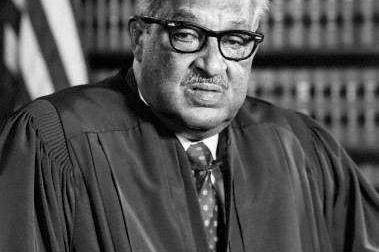
Thurgood Marshall and His Lasting Impact on American Justice
Few figures in American history reshaped the legal landscape as profoundly as Thurgood Marshall. Born in 1908 in Baltimore, Maryland, Marshall grew up in a segregated America where opportunities for Black citizens were systematically limited. Yet through determination and brilliance, he became a central architect of the modern civil rights movement and eventually the first African American Justice of the U.S. Supreme Court.
Marshall first rose to national prominence as a lawyer for the National Association for the Advancement of Colored People (NAACP). As chief counsel, he traveled across the country challenging segregation and racial injustice in the courts. His strategy was methodical: dismantle “separate but equal” by proving that separate was inherently unequal. This legal campaign culminated in the landmark 1954 Supreme Court decision Brown v. Board of Education, which declared racial segregation in public schools unconstitutional. The ruling overturned the precedent set by Plessy v. Ferguson and marked a turning point in American history.
The impact of Brown v. Board of Education extended far beyond classrooms. It energized the broader civil rights movement, providing legal and moral momentum for activists seeking equality in voting rights, housing, and public accommodations. Marshall’s work demonstrated how the Constitution could be used as a tool for social change, reinforcing the idea that the law is not static but can grow toward greater justice.
In 1967, President Lyndon B. Johnson appointed Marshall to the Supreme Court. His confirmation was historic, but his presence on the bench was more than symbolic. During his 24 years as a Justice, Marshall consistently advocated for individual rights, equal protection under the law, and protections for the accused. He was a strong opponent of the death penalty and a defender of affirmative action, believing that the law must actively address systemic inequality.
Thurgood Marshall’s legacy lies not only in the cases he won but in the doors he opened. He transformed the judiciary into a more inclusive institution and inspired generations of lawyers, judges, and activists. His life’s work reminds us that justice requires courage and that one determined advocate can help bend the arc of history toward equality.
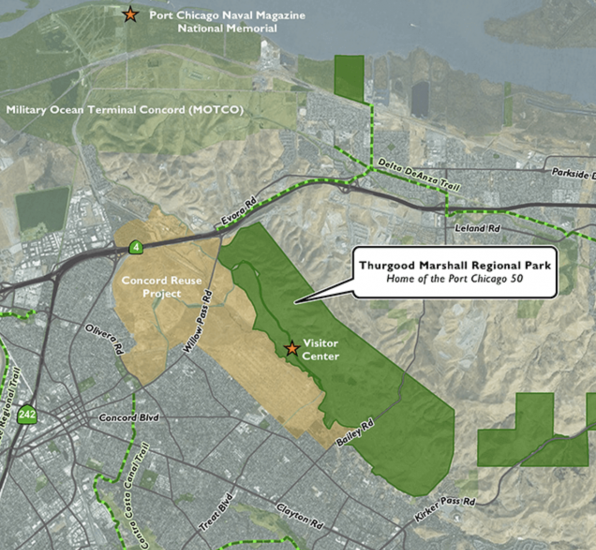
Located in the Concord Hills and the ancestral territory of the Chupcan Peoples, Thurgood Marshall Regional Park – Home of the Port Chicago 50 aims to share stories of social injustice and bravery, connect community, and offer protected space for both nature and people to heal.
The future park will include:
A visitor center featuring local histories, including the 1944 Port Chicago Disaster that killed over 320 men—most of whom were Black sailors—the mutiny trial that followed, and the social justice efforts that ultimately contributed to the desegregation of the U.S. Navy.
3,000 acres of open space designed to connect Concord communities, with expanded public transit routes, new public access points, and staging areas.
Recreational opportunities such as camping, hiking, biking, and picnic areas.
Protected habitats and wildlife corridors to support native species of the region.
Together, the vision for Thurgood Marshall Regional Park – Home of the Port Chicago 50 is to honor the past, protect the future, and provide access for all.
While the future park is currently closed to the general public, special curated events, naturalist-led programs, and guided public tours take place throughout the year to allow safe and meaningful access. Stay up to date with details and upcoming events by visiting:
https://www.ebparks.org/parks/thurgood-marshall-regional-park-home-port-chicago-50